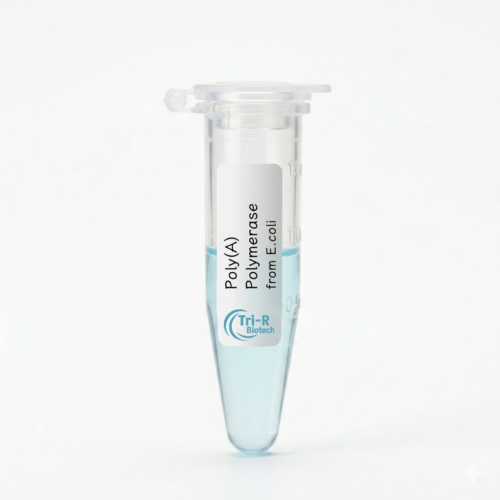
Poly(A) Polymerase from E. coli
一種催化腺苷酸單元以非範本依賴方式添加到RNA分子3'羥基末端的酵素,通常用於在新合成RNA添加poly(A)尾以增強RNA穩定性、RNA標誌或下游操作。
請選擇數量
產品規格表
| 產品編號 | MBE108 |
| 產品名稱 | 大腸桿菌Poly(A)聚合酶 Poly (A) Polymerase from E. coli |
| 濃度 | 5 U/μl |
| 分子量 | 55 kDa/single subunit |
| 儲存溶液 | 50% 甘油溶液(Glycerol solution) |
| 生物來源 | 大腸桿菌 Escherichia coli |
| 表現系統 | 大腸桿菌(Escherichia coli) |
| 運送溫度 | 低溫 |
| 保存溫度 | 低於 -20°C,避免反覆凍融 |
| 安定性 | 於 -20°C 可穩定保存至少 1 年;詳細資訊請參閱試劑瓶標示。 |
| 活性單位定義 | 一個活性單位是指在 37°C 下,於 20 µL 反應體積中,10 分鐘內催化 1 nmol AMP 摻入 RNA 所需之酵素量。 One unit is defined as the amount of enzyme that will incorporate 1 nmol of AMP into RNA in a 20 µl volume in 10 minutes at 37°C. |
產品介紹
大腸桿菌Poly(A) Polymerase是一種重要的RNA修飾酶,由pcnB基因編碼。該酶屬於模版非依賴性RNA聚合酶,能夠催化ATP分子逐步添加到RNA分子的3'羥基末端,形成多聚腺苷酸尾。
在原核生物中poly(A)聚合酶的主要功能是參與mRNA的降解與品質控制,poly(A)尾通常標記RNA分子以便被核糖核酸外切酶識別並降解。此外,該酶還在rRNA和tRNA的成熟與代謝過程中發揮調控作用,幫助清除異常或受損的RNA分子。
大腸桿菌Poly(A) Polymerase的持續合成能力相對較低,通常只能添加約20-40個腺苷酸殘基。其活性受多種蛋白質調控,例如聚腺苷酸結合蛋白可增強其催化活性。該酶在分子生物學研究中具有重要應用價值,常用於體外為RNA添加poly(A)尾,以促進mRNA的穩定性、提高轉譯效率,或用於cDNA合成、基因選殖及高通量定序文庫構建等實驗技術。
Product Description
Escherichia coli Poly(A) Polymerase (PAP) is an essential RNA-modifying enzyme encoded by the pcnB gene. As a template-independent RNA polymerase, it catalyzes the sequential addition of ATP molecules to the 3'-hydroxyl terminus of RNA substrates, generating a polyadenylate [poly(A)] tail.
In prokaryotes, the primary function of poly(A) polymerase is to facilitate mRNA degradation and quality control. The bacterial poly(A) tail typically serves as a degradation signal recognized by exoribonucleases. Additionally, this enzyme plays regulatory roles in the maturation and turnover of rRNA and tRNA, helping to eliminate aberrant or damaged RNA molecules.
E. coli Poly(A) Polymerase exhibits relatively low processivity, typically adding approximately 20–40 adenylate residues. Its enzymatic activity is modulated by various accessory proteins; for instance, poly(A)-binding proteins can enhance its processivity. The enzyme holds significant value in molecular biology research and is commonly employed in vitro to append poly(A) tails to RNA molecules. This modification can improve mRNA stability and translational efficiency, and is widely utilized in applications such as cDNA synthesis, molecular cloning, and next-generation sequencing library preparation.